[Total No. of Questions - 8]
[Total No. of Printed Pages - 2]
B.E. vth Semester Examination
BE-V/6(B)
216351
Computer Engineering
Course No. COM-504
Automata and Formal Languages
New Syllabus
Note: Attempt any five questions selecting at least two questions from each section. All questions carry equal marks.
Section - A
-
- Prove that if r is a regular expression, then there exists a NFA with E-transitions that accepts L(r).
- What are the applications of finite automata?
-
- Construct a non deterministic finite automata accepting the set of all strings over {a,b} ending in aba. Use it to construct a DFA accepting the same set of strings.
- Define a regular expression. Whar are its properties?
-
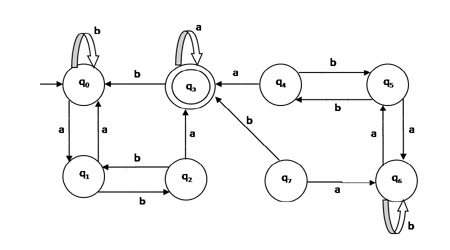
- Construct a minimum state automata equivalent to the following transition diagram:
- Prove that for any transition function d(del)and for any two input strings x and y:
d(q,xy) = d(d(q,x)y) [here d denotes del]
-
- What is pumping lemma. What are its applications?
- Construct a finite automata for accepting all possible strings of zero's and one's which does not contain 001 as substring.
- Construct a mealy machine which is equivalent to the following moore machine:
Present State Next State Output a = 0 a = 1 —> q0 q1 q2 1 q1 q3 q2 0 q2 q2 q1 1 q3 q0 q3 1
Section - B
-
- Write a short note on acceptors and generators.
- Explain different types of turing machines.
-
- Reduce the following grammer to CNF:
S —> abSb | a | aAb, A —> bS | aAAb - Explain Greibach Normal Form with a suitable example.
- Reduce the following grammer to CNF:
-
- What is ambiguity. Differentiate between leftmost and rightmost derivation trees.
- What do you mean by useless symbols.
-
- Construct a pushdown automata acceptin:
{ an b2n / n > 1 } - Explain the halting problem of turing machines.
- Construct a pushdown automata acceptin: